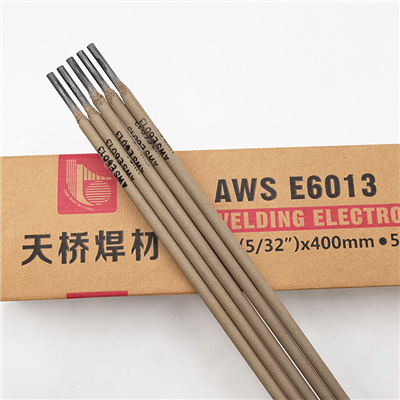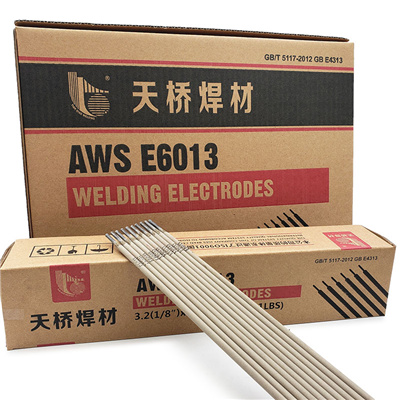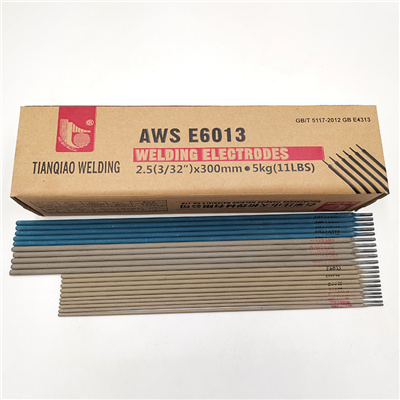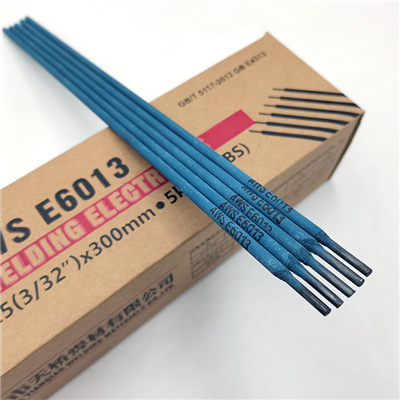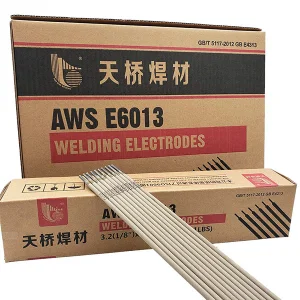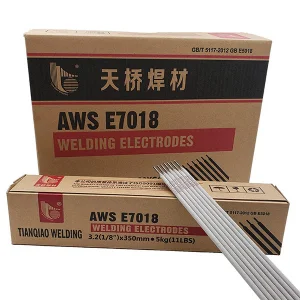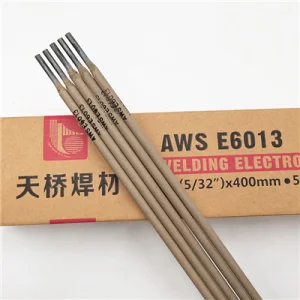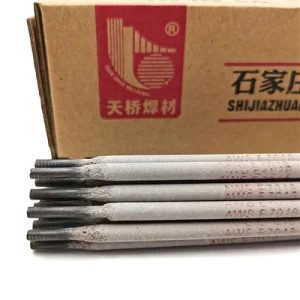
China Mild steel welding electrode E6013 rutile grade Manufacturer, Factory

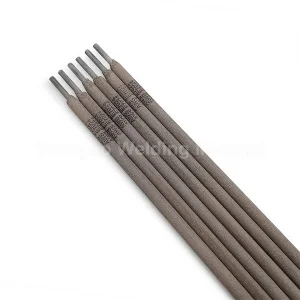
Rutile grade E6013 is with better quality and has been exported to many countries in Europe (Germany, Poland, Italy, France...etc). It is suitable for welding of low carbon steel structure, especially for the welding of thin plate steel with short discontinuous weld and requirement of smooth welding pass.

Product Description

Mild Steel Welding Electrode E6013 Rutile Grade
🏗️
APPLICATIONS

Specifically designed for welding low carbon steel structures. It excels in thin plate steel welding, short discontinuous welds, and applications requiring a smooth, aesthetic welding pass.

⚙️
CHARACTERISTICS

J421 is a premium rutile type electrode. Compatible with both AC and DC power sources, it supports all-position welding. Key features include a stable arc, minimal spatter, effortless slag removal, and excellent reignition-ability.

WELDING POSITIONS
PA PB PC PD PE PF
DEPOSIT COMPOSITION (%)
Items C Mn Si S P Ni Cr Mo V
Requirements ≤0.10 0.32-0.55 ≤0.30 ≤0.030 ≤0.035 ≤0.30 ≤0.20 ≤0.30 ≤0.08
Typical Results 0.08 0.37 0.18 0.020 0.025 0.030 0.035 0.005 0.004
MECHANICAL PROPERTIES
Items Tensile Strength (Rm/MPa) Yield Strength (Rel/Rp0.2 MPa) Elongation (A/%) Charpy V-Notch (KV2/J) 0℃
Requirements 440-560 ≥355 ≥22 ≥47
Typical Results 500 430 27 80
⚠️ ATTENTION & DRYING INSTRUCTIONS:

In general, there is no need to re-dry the electrode before welding. However, if the electrodes are affected by dampness, they should be re-dried at 150℃-170℃ for 0.5 to 1 hour to ensure optimal performance.
Frequently Asked Questions (FAQ)
1. What is the difference between E6013 and J421 welding electrodes?
E6013 is the AWS (American Welding Society) classification, while J421 is the equivalent Chinese standard (GB) for a rutile-type carbon steel electrode. They share the same characteristics, such as all-position welding and stable arc performance.
2. Can I use E6013 electrodes for vertical welding?
Yes, E6013 is an "all-position" electrode, meaning it is suitable for flat (PA), horizontal (PC), vertical-up (PF), and overhead (PE/PD) welding positions.
3. What power source is best for E6013 rutile grade electrodes?
E6013 is very versatile and can be used with both AC and DC (Direct Current) power sources. This makes it an excellent choice for small shops and DIY projects where only basic welding machines are available.
4. Why is E6013 preferred for thin sheet metal?
Because it has a shallow penetration and a very stable, soft arc, it reduces the risk of "burn-through" on thin materials. It also produces a very smooth bead with easy slag removal.
5. Do I need to bake E6013 electrodes before use?
Under normal storage conditions, E6013 does not require drying. However, if they have been exposed to high humidity, baking them at 150°C-170°C for 30-60 minutes will restore their welding quality.
6. What are the typical mechanical strengths of an E6013 weld?
Typical results for E6013 show a tensile strength of around 500 MPa and a yield strength of 430 MPa, which exceeds the minimum requirements for most low-carbon steel structural projects.

Related Products