Why choose a Carbon Steel Welding Electrode when stainless steel and advanced alloys receive more attention? The answer begins with scale. The World Steel Association’s World Steel in Figures 2024 reports approximately 1.89 billion tonnes of crude steel production in 2023. Carbon steel remains central to construction, machinery, transportation, pipelines, and general fabrication. Its widespread use creates strong demand for dependable, compatible welding consumables.
A Carbon Steel Welding Electrode offers practical advantages on busy fabrication floors. Common classifications, such as E6013 and E7018, provide familiar operating characteristics and broad availability. E6013 is often selected for clean, accessible joints and moderate fabrication work. E7018 supports higher-strength applications when low-hydrogen practice is followed. The American Welding Society’s AWS A5.1 specification defines requirements for covered carbon steel electrodes, helping buyers compare performance consistently. That matters when a welder must control arc stability beside a steel frame at 6 a.m.
The choice is not automatic. Moisture, incorrect storage, poor surface preparation, and unsuitable current can weaken results. E7018 electrodes, for example, require careful handling because absorbed moisture may increase hydrogen-related cracking risk. The American Welding Society and ISO welding standards emphasize procedure control, qualification, and inspection rather than casual product selection. A low purchase price can become expensive after grinding, repair, or failed inspection. That lesson is easy to overlook.
For many workshops, carbon steel electrodes balance availability, weldability, strength, and cost. Their value is practical, not fashionable. Still, engineers should match the electrode classification with steel grade, joint design, service temperature, and applicable code. Experienced welders know the final bead tells only part of the story. Process discipline tells the rest.
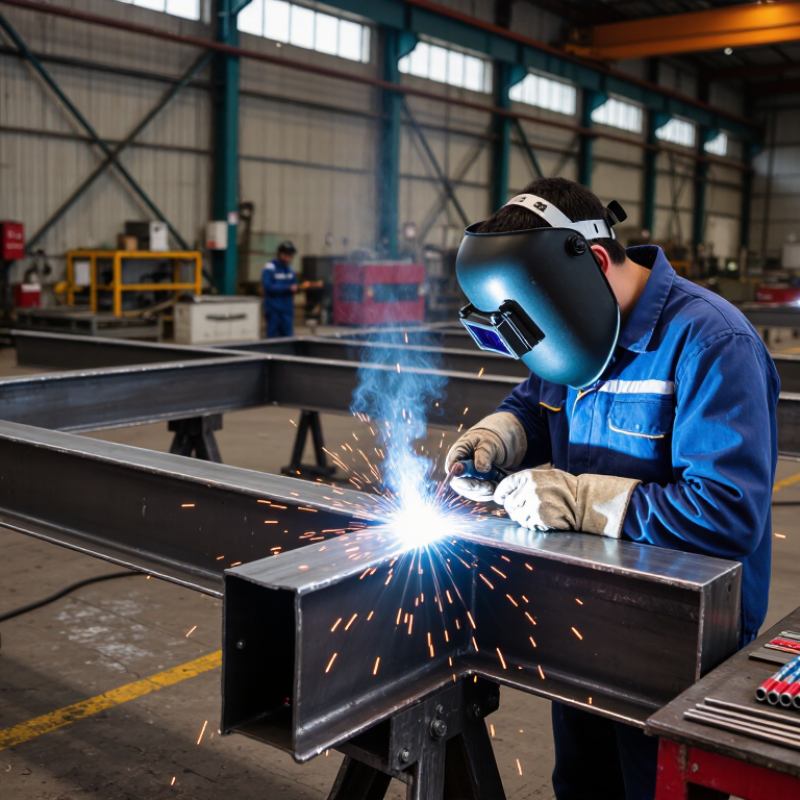
Carbon steel electrodes remain practical because they tolerate common shop conditions and support many repair and fabrication tasks. The AWS A5.1/A5.1M specification gives users a clear classification system for shielded metal arc welding electrodes.
In E6010, “60” indicates 60 ksi minimum tensile strength. The final digits identify coating type, welding position, and current suitability. E6010 uses a forceful arc and deep penetration, making it useful for root passes and contaminated steel. E7018 provides 70 ksi minimum tensile strength and a low-hydrogen coating. Its arc feels smoother, with less spatter and a more controlled bead.
A neat bead can deceive.
Electrode choice still depends on joint design, steel thickness, polarity, and welder experience. AWS A5.1 also requires performance tests for deposited metal chemistry, mechanical properties, and usability. That detail matters more than a product label alone. The American Welding Society’s welding consumables standards remain a major technical reference for qualification and purchasing decisions.
Global demand gives this choice broader context. World Steel Association data records approximately 1.89 billion tonnes of crude steel production in 2023. Much of that steel enters equipment, infrastructure, and maintenance work where portable electrodes remain valuable. In field welding, E6010 can open a root effectively, while E7018 can support stronger fill and cap passes. However, low-hydrogen electrodes need controlled storage and handling. I have seen otherwise sound welds suffer when moisture control was treated as an afterthought. That weakness deserves honest attention.
| AWS A5.1 Classification | Minimum Tensile Strength | Minimum Yield Strength | Minimum Elongation | Coating Type and Main Characteristics | Recommended Current and Polarity | Welding Positions | Typical 3.2 mm Current Range | Common Applications |
|---|---|---|---|---|---|---|---|---|
| E6010 | 60 ksi (430 MPa) | 48 ksi (330 MPa) | 22% | Cellulosic sodium coating. Produces a forceful, digging arc with deep penetration and a fast-freezing slag. | DC+ (DCEP) | All positions, including vertical-down pipe welding | 75–125 A | Root passes, open-root pipe welding, field repairs, and applications requiring deep penetration. |
| E6011 | 60 ksi (430 MPa) | 48 ksi (330 MPa) | 22% | Cellulosic potassium coating. Similar penetrating characteristics to E6010, with AC capability and a forceful arc. | AC or DC+ (DCEP) | All positions, including vertical-down pipe welding | 80–130 A | Maintenance welding, repair work, outdoor fabrication, and welding where AC power is available. |
| E6012 | 60 ksi (430 MPa) | 48 ksi (330 MPa) | 22% | Rutile sodium coating. Provides a smooth arc, moderate penetration, and a relatively thick, easily controlled slag. | AC, DC+ (DCEP), or DC− (DCEN), subject to product qualification | All positions except vertical-down for typical applications | 90–130 A | General fabrication, fillet welds, sheet metal, and joints where a smooth bead profile is preferred. |
| E6013 | 60 ksi (430 MPa) | 48 ksi (330 MPa) | 22% | Rutile potassium coating. Easy striking and restriking, smooth arc behavior, and easy slag removal. | AC, DC+ (DCEP), or DC− (DCEN), subject to product qualification | All positions; vertical-down use depends on the qualified procedure | 80–130 A | Light and general fabrication, tack welding, thin-to-medium carbon steel, and repair work. |
| E7014 | 70 ksi (490 MPa) | 57 ksi (390 MPa) | 22% | Iron powder titania coating. Offers a higher deposition rate than standard rutile electrodes and a smooth, easy-to-remove slag. | AC, DC+ (DCEP), or DC− (DCEN), subject to product qualification | All positions except vertical-down for typical applications | 90–140 A | Structural fillets, general fabrication, lap joints, and work requiring higher deposition efficiency. |
| E7016 | 70 ksi (490 MPa) | 57 ksi (390 MPa) | 22% | Low-hydrogen potassium coating. Designed to reduce hydrogen-related cracking when correctly stored, handled, and used. | AC or DC+ (DCEP) | All positions | 90–130 A | Restrained joints, structural carbon steel, pressure-related fabrication, and welds requiring low-hydrogen practice. |
| E7018 | 70 ksi (490 MPa) | 57 ksi (390 MPa) | 22% | Low-hydrogen iron powder coating. Provides a smooth arc, stable bead appearance, good toughness, and increased deposition efficiency. | AC or DC+ (DCEP); use the power source specified by the product qualification | All positions | 90–140 A | Structural steel, bridges, buildings, pressure vessels, heavy equipment, and critical carbon steel joints. |
“E” means electrode. “70” indicates 70 ksi minimum tensile strength, or about 483 MPa. “1” indicates all-position use. “8” identifies a low-hydrogen, iron-powder type.
It requires at least 70 ksi tensile strength under specified test conditions. The listed minimum yield strength is 58 ksi. Minimum elongation is 22 percent. These values support comparison, not certainty.
No. Fit-up, heat input, travel speed, and technique change the final weld. A strong test result cannot repair poor preparation. The numbers look reassuring. That assumption is risky.
Moisture can increase hydrogen-related cracking risks, especially in restrained joints. Store electrodes under controlled conditions. Keep the package and storage area dry. Small moisture exposure may become a large repair problem.
It may suit thick plates, stiff connections, and structures facing repeated loading. These applications can be sensitive to delayed cracking. Suitable preheat and clean joint faces remain necessary. The electrode alone is not enough.
Vertical and overhead welding require controlled bead placement. A stable arc at lower current may improve handling. Position changes everything. An electrode suitable for flat welding may feel difficult overhead.
The procedure should address preheat and interpass temperature. It should also cover essential variables and qualification requirements. The approved procedure must match the selected classification. Missing paperwork can hide practical mistakes.
Teams may focus on deposition speed while ignoring fit-up or moisture exposure. Contaminated grooves and rushed preheat can undermine the weld. Production pressure encourages shortcuts. Experienced crews can still miss details.
Choosing the right Carbon Steel Welding Electrode is essential for achieving strong, reliable, and safe welds. AWS A5.1 provides a useful classification system for common electrodes such as E6010 through E7018. In these codes, the first two numbers indicate the minimum tensile strength; for example, E7018 delivers at least 70 ksi. The coating and operating characteristics also differ: E6010 is known for deep penetration, while E7018 features a low-hydrogen coating that helps reduce the risk of hydrogen-related cracking.
Electrical compatibility is another important consideration. E6013 can operate with either AC or DC, making it a flexible option for many general fabrication tasks. E7018 is typically used with AC or direct current electrode positive (DCEP) to support stable, high-quality welds. For structural projects, AWS D1.1 helps guide electrode selection according to the steel type, joint design, welding position, and service requirements, ensuring the chosen electrode matches the application.

 Tianqiao Welding